
Defibrillators for Workplaces
Employees, visitors and contractors may need a defibrillator at any time of day. This guide helps an office, factory, warehouse or multi-site business choose a defibrillator, decide where it goes and keep it ready.
Do workplaces need a defibrillator?
In most workplaces there is no specific legal duty to provide a defibrillator, but employers must assess their first-aid needs, and that assessment should consider whether one is appropriate. Check the current HSE guidance on first aid at work. Many employers decide to provide one because of the size of the site, the number of people, the age of the workforce, remote areas or visitors.
What to look for in a workplace AED
- One model across every siteIf you have more than one site, the same model everywhere means staff know how to use it wherever they are, and spares and replacement pads are simple to order.
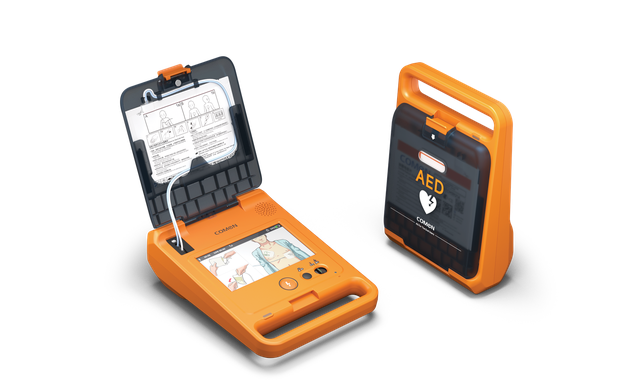
- Clear voice prompts, in the right languageThe Comen G Series switches language at the touch of a button and adjusts its volume automatically in noisy places.
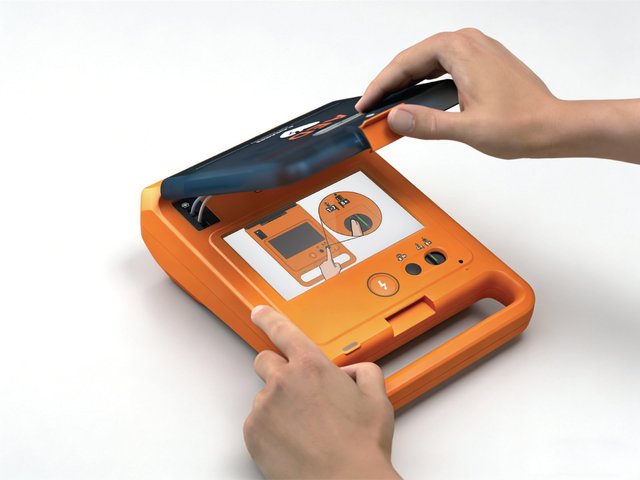
- Easy upkeepSelf-testing, clearly dated pads, and a disposable maintenance-free battery. Wi-Fi, cellular and Bluetooth connectivity options are available on some models (availability may vary).
- Adult and child useVisitors can be any age. Adult and paediatric pads are pre-connected on the G Series.
Where to place it and how many you need
Put it in a central, well-signed spot such as reception, and think about shift workers, night staff and areas that are far from reception. A common rule of thumb is that a defibrillator should be reachable within about three minutes of a collapse, so a large building, several floors or a spread-out site may need more than one. Include it in your site plan, your induction and your emergency procedures.
People and training
Name a person, and a deputy, responsible for checking the defibrillator and ordering replacements. No formal training is needed to use an AED, because it gives voice prompts, but CPR and AED awareness for first aiders and staff is recommended.
Looking after it
Check the status indicator on a regular routine, for example weekly, and keep a simple log. Note the expiry dates of the pads and the battery so replacements are ordered in time. The G3 and G3A pads have a validity period of 42 months, and their battery is disposable and maintenance-free with a standby life of more than 6 years under the manufacturer's stated conditions. Replace the pads after any use. We supply replacement defibrillator pads for the G Series and for most other makes. Register the defibrillator on The Circuit, the national defibrillator network, so that the ambulance service can direct a 999 caller to it.
Which defibrillator do we suggest?
We suggest the Comen G Series AED (G3, G3A, G5 and G5A): voice-guided, with adult and paediatric pads pre-connected, up to 360 J, and IP55 protection. Semi-automatic and fully automatic versions are available. Tell us about your business and we will suggest the right model and send a quote. Standard dispatch is 48 hours.
OscarTech UK is an approved supplier on the NHS Supply Chain framework for external defibrillation devices and related services and accessories. If you buy through NHS Supply Chain, contact us to confirm whether the model you need is available under the framework.
This page is general information, not medical advice. Follow your local first-aid and resuscitation guidance and seek clinical advice where you need it.
Is a workplace legally required to have a defibrillator?
In most workplaces there is no specific legal duty to provide one, but the first-aid needs assessment you must carry out should consider it. Check the current HSE guidance and any requirements from your insurer.
How many defibrillators does a workplace need?
A common rule of thumb is that one should be reachable within about three minutes of a collapse. A large site, several floors or separate buildings may need more than one.
Can we use the same model at every site?
Yes, and it helps. Staff learn one device, and you only need to stock one set of pads and batteries.
Who should look after the defibrillator?
Name one person, and a deputy, to check the status indicator regularly, keep the log and order replacement pads and batteries before they expire.
Do our staff need training?
No formal training is needed to use an AED, because it gives voice prompts, but CPR and AED awareness is recommended, especially for first aiders.
How do we get a quote?
Use the form. Tell us about your site and we will come back with a suggested defibrillator and a quote.
Tell us about your site or sites. We will suggest a defibrillator and send you a quote.
Get a defibrillator for your businessCouldn't find what you're looking for?
Our team can help source the right instrument or confirm a specific reference code for your setting.